Books
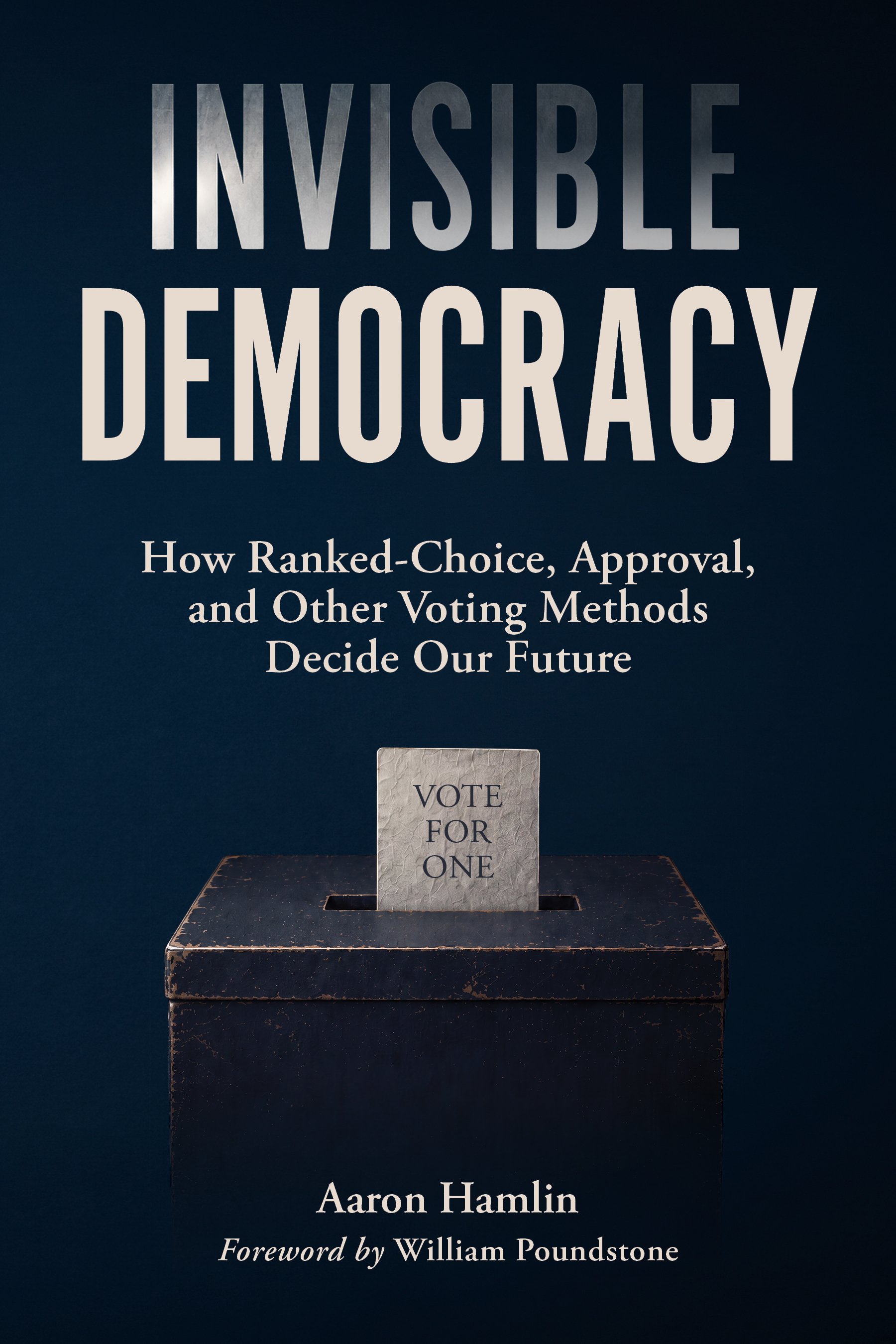
Coming in 2026: Invisible Democracy
What if the way we vote is the reason our democracy feels broken? Invisible Democracy runs through the stories and data of our elections to tell how voting methods quietly shape the formation of our government—and how simple changes can put the voters back in charge.
Most people don’t think about how they vote: pick one candidate, cast your ballot, done. But this "choose-one" system distorts outcomes and sidelines fresh voices. No wonder elections feel frustrating and unfair.
There’s a better way. Approval voting lets you vote for every candidate you support, giving a clearer picture of how voters really feel. This voting method addresses vote-splitting, encourages new voices, and provides an opportunity for consensus candidates to thrive. Cities like Fargo and St. Louis have already started using it—and it could reshape democracy nationwide and beyond.
Excerpt:
Author’s Note: Who This Book Is For (And Who It Isn’t)
I wrote this book because voting methods are critical, sometimes complicated, and (for the average person) obscure. Obscure enough that I have to explain right now what I even mean by a voting method:
A voting method has three parts:
Information you provide: whether it’s picking one, ranking, scoring, or choosing multiple candidates.
Calculation: such as elimination rounds, simple addition, averaging, or head-to-head comparisons.
Selection of winners: determines whether you’re filling one seat or more.
The voting method is the connection between what the voter desires and who gets elected. It’s your most important tool, and the only one with bite—so long as you have a good method. You might recognize some different voting method names. The choose-one method we use here in the U.S. (and pervasively across the world) is called plurality voting or first past the post. You may have heard of ranked-choice voting, which I’ll refer to as instant-runoff voting in this book. Approval voting, a name that might look unfamiliar right now, is one we’ll talk about frequently.
This book will look at single- and multi-winner systems, primaries, and ancillary components of a democracy’s architecture. I’ll provide a structure you can follow for evaluating all this, and I’ll back up any recommendations. Plus, I’ll show how to implement recommended reforms in practice, drawing from real successes I’ve been part of. As a bonus, I’ll share stories and interviews along the way to keep your interest. There will be many!
So if you’re willing to critically engage and explore new ways of thinking about our elections, then keep reading. This will be worth your time. You’ll have a hard time finding another book that’s both as comprehensive and accessible.
What This Book Promises
At minimum, this book will demystify how voting methods shape our elections. Here’s some of what you’ll learn:
How to evaluate and think about voting methods.
Why “choose-one” voting fails and warps the rest of the system.
How approval voting improves elections just by letting voters select any number of candidates.
Where instant runoff/ranked choice voting succeeds and fails.
How primaries, multi-winner systems, and complementary reforms fit in.
What’s at stake if we can’t get this right.
What it takes to actually make reform happen and what your role is.
How This Book Is Written
When I look at problems, especially complex ones, I ask fundamental questions: like what makes a voting method good and how we measure that. This book does the same. While at times technical, I promise to stay accessible (without talking down to you).
If anything seems tricky, please stick with it. It’ll be worth it. I’m going in assuming you don’t know anything. Notice how I didn’t even assume you knew what a voting method was. I’m fine holding your hand. I had to learn all this at some point too. You don’t need to be a political scientist or mathematician to follow this book. But you do need curiosity and a willingness to think critically.
It’s not my goal to overwhelm you with theory or abstract models, although we will cover a lot. My goal is for you to leave this book understanding not just how different voting methods work, but why they matter and what we can do about them.
Why You Should Listen to Me
For over a decade, I’ve been on the front lines of voting reform. I’ve helped the first cities adopt approval voting and pioneered new research on better voting methods. I also built an advocacy and election research organization from scratch. And I’m doing it again with a new research organization, Ballot Lab. I developed control measures to compare voting methods and have written peer-reviewed publications on approval voting and more generally on tactical voting.
I’m giving you what took me over that decade to learn. I’m used to translating technical topics—particularly this one—for lay audiences while not straying away from the details. This experience comes from countless interviews in popular media on election reform. Even if you also work in this space, I’m confident you’ll still pick up many nuggets along the way. There’s something for everyone here.
Worried About Partisanship?
Elections are inherently partisan, even if there aren’t party labels. We have different ways of looking at the world—all of us. And that’s okay. In fact, it’s good.
This book will take swings at every party—not just major parties but occasionally also third parties. Major parties will take the most heat, however, because they tend to use their power to stack the deck in their favor, which they do at the expense of everyone, including you. It’s fine if you’re empathetic with your group, but I just ask that you not reflexively close the book when your team takes its turn. I don’t know when your order will come up.
Go Time
If we fail at the most basic component of choosing our leaders, then everything else is at risk. Voting methods aren’t just a bureaucratic detail. They determine who governs our lives and whether our system even functions. It’s the biggest lever affecting the world we see. It’s time we stop treating voting methods and their complementary reforms as an afterthought. We must instead demand and do better. Let’s begin.
Early Table of Contents
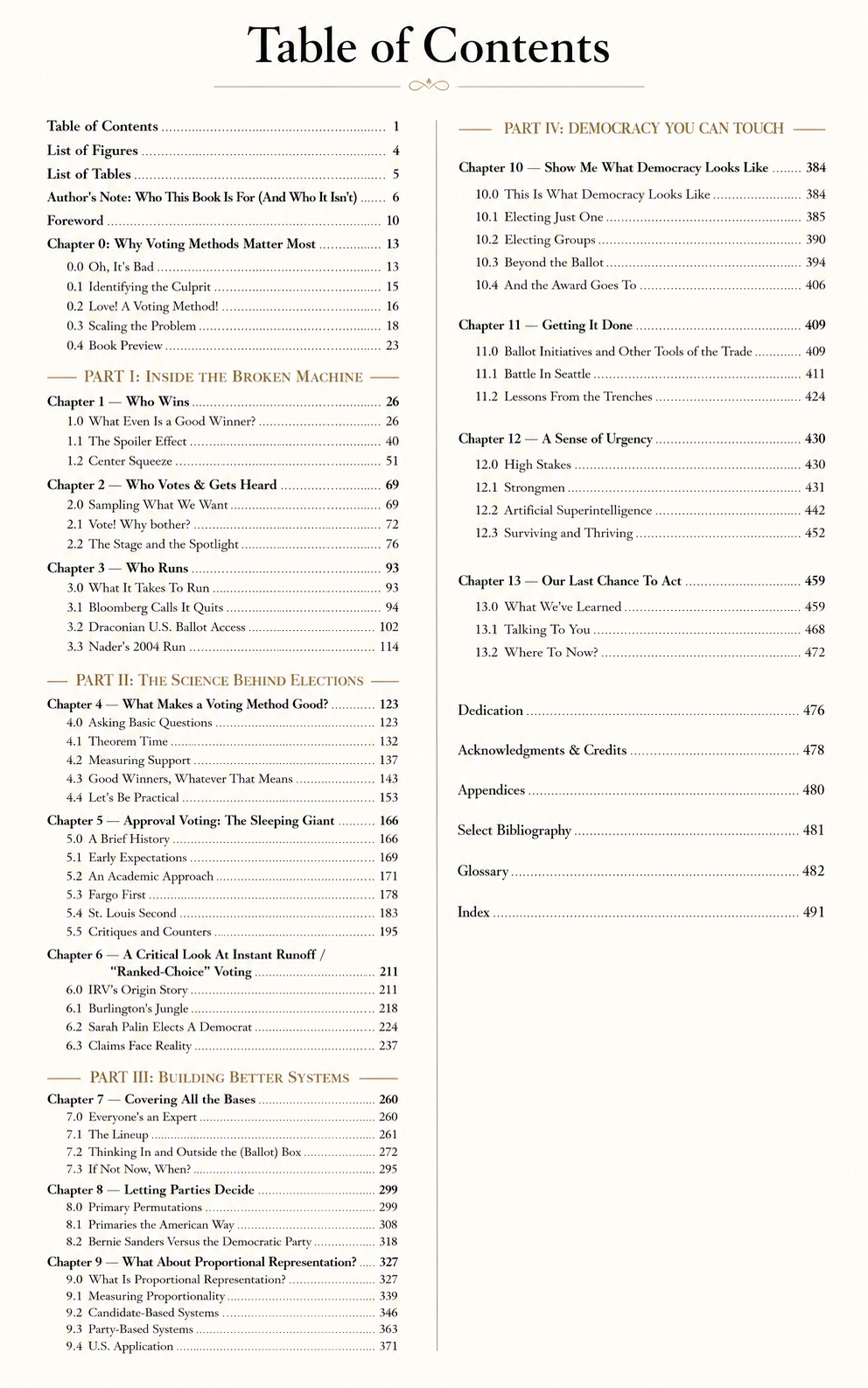
If you’ve ever felt like elections don’t represent you, Invisible Democracy will show you how to change the game—and why it starts with rethinking the ballot.
Sign up below for updates and other early access to this groundbreaking book and related work!
For media, sponsoring the book via my fellowship, and other requests, visit the contact page.